
Why not to track your employees with AI
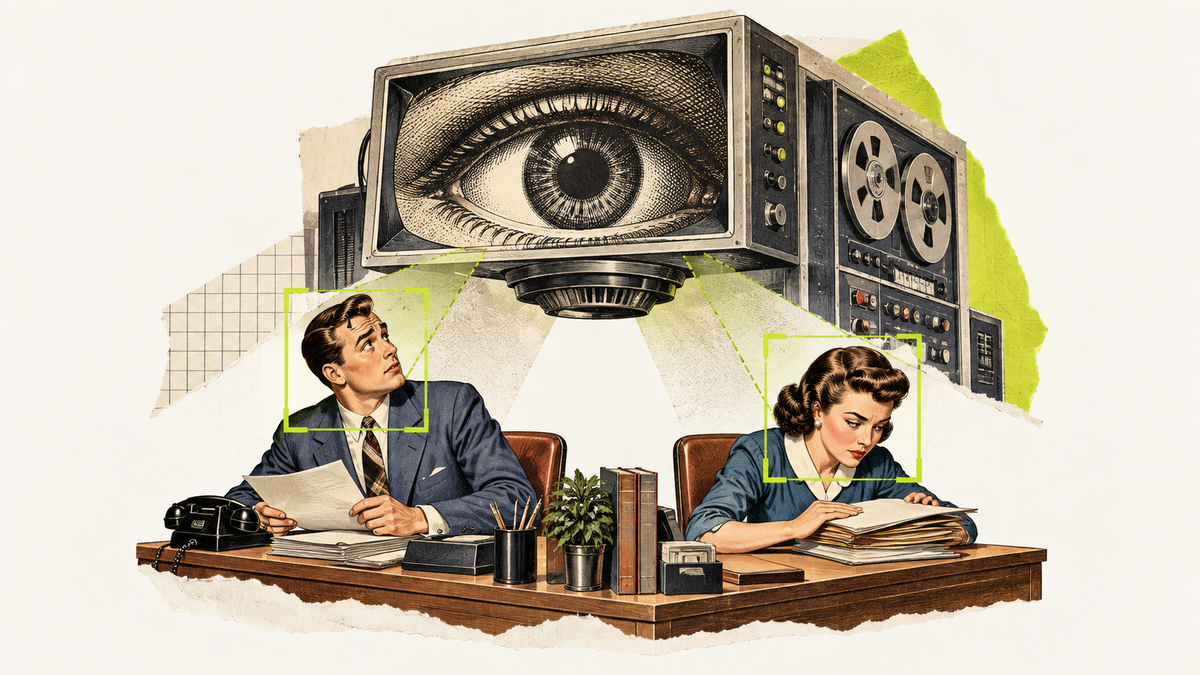
AI made watching your team almost free. The research says it costs more than it returns — in trust, in performance, and in the people you can least afford to lose. What to do instead.
The pitch, and the catch
Somewhere in your inbox is a vendor offering to tell you, finally, what your people are doing all day.
Screen activity scored by the minute. Slack messages run through sentiment analysis. "Focus time" inferred from keystrokes. A dashboard with a productivity number next to every name, updated continuously, at a price that would have been unthinkable five years ago. The pitch is visibility. The subtext is control.
The catch is in a piece Guido Friebel, a professor of human resources at Goethe University Frankfurt, published in Harvard Business Review this month. His argument is not that monitoring is evil. It is that AI has made monitoring so cheap, so granular, and so continuous that companies are adding controls without ever asking what they cost — and the research on what they cost is not encouraging. Monitoring can undermine trust, lower performance, and push experienced employees out the door, even as it gives useful structure to people who are new. The question, he argues, is not "more or less monitoring" but "how much control is appropriate for whom, and for what", and every control should have to justify its costs before it is switched on.
We agree. Here is the evidence, and here is what to do instead.
What the research actually says
It makes people tense, and they know it. The American Psychological Association's 2023 Work in America survey asked workers whether they were monitored at work and how they felt during the day. Among those who were monitored, 56% said they typically felt tense or stressed, against roughly 40% of those who were not. Monitored workers were also far more likely to say their workplace hurt their mental health (45% versus 29%), and to say their employer thought the place was healthier than it really was. That last one matters: it means the dashboard is telling you things are fine while the people on it are telling you they are not.
It makes rule-breaking more likely, not less. This is the finding that surprises people. A study by Chase Thiel and colleagues, published in the Journal of Management and summarised in HBR, ran two experiments and found that monitored employees were substantially more likely to break rules — cheating on a test, taking equipment, deliberately working slowly. The mechanism was a shift in responsibility. When people knew they were watched, they stopped feeling like the author of their own behaviour and started treating the person watching as the one accountable for it. Monitoring did not replace their conscience; it switched it off. The one thing that softened the effect was fairness: people who felt they were treated well kept their sense of agency and behaved accordingly.
It measures activity, not work — and people respond by performing activity. Microsoft's 2022 Work Trend Index surveyed 20,000 people across eleven countries and found that 85% of leaders said hybrid work made it hard to be confident their people were productive, while 87% of employees said they were. Microsoft's own read of the gap was blunt: when organisations track activity instead of impact, and employees do not know how or why they are tracked, trust erodes and people start performing busyness for the tracker. They called it productivity theatre. A monitoring tool does not close that gap. It industrialises the theatre.
The people who leave are the ones you wanted to keep. Friebel's summary of the research is that turnover rises specifically among experienced employees. The pattern shows up wherever a control signals distrust: a Gartner survey of roughly 2,000 knowledge workers found that when companies imposed strict return-to-office mandates, high performers' intent to stay dropped by twice as much as everyone else's, because they read the mandate as a message that a track record still did not buy them autonomy. Surveillance sends the same message, louder, every day. Your most experienced people are the ones with options, and the ones least willing to be scored by the minute.
And it is already everywhere. An ExpressVPN survey of 1,500 US employers found around three-quarters using online tracking tools and about six in ten using AI-powered analytics on them. This is not a fringe practice you can wait out. It is the default your vendors are selling, which is exactly why the decision needs to be made on purpose.
Why it fails as a management tool
Put the studies aside for a moment and think about what the dashboard is actually doing.
It measures the wrong thing. Keystrokes, active windows, and message counts are what is easy to capture, not what matters. The best engineer on your team spent Tuesday thinking. The best salesperson spent it on a walk with a prospect. Both scored badly. The person who scored well had six windows open and got nothing done.
Once it is a target, it stops being a measure. Anything you score, people optimise. Mouse-jigglers, calendar-padding, "active" status on a second monitor. You will not stop this. You will just have moved the work from the job to the performance of the job.
The AI layer makes wrong conclusions confident. Older monitoring recorded. AI monitoring interprets: it decides someone is disengaged, or a flight risk, or underperforming, and presents the inference as a finding. The inference is trained on patterns that may have nothing to do with your team, and the manager reading it has no way to know. A confident wrong number is worse than no number, because it gets acted on.
It gives structure to the wrong people. Friebel's point about less experienced workers is right: someone in their first month benefits from tight feedback and clear expectations. But a surveillance tool applies the same intensity to the twenty-year veteran, who needs none of it and resents all of it. Blanket monitoring is the most expensive way to give a new hire structure.
You become the thing your best people route around. Once a team knows it is scored, the relationship changes. Managers stop being the people you tell about problems and start being the people the dashboard reports to. That silence costs more than any productivity gain the tool ever claimed.
The special case: monitoring who uses AI
There is a version of this that arrives wearing a friendly badge. "We're not surveilling anyone — we just want to see which teams are adopting AI." A leaderboard of prompts sent. A report of who has and has not opened the tool.
It is the same thing. It measures activity instead of outcomes, it turns a tool people might have liked into a thing they are watched through, and it produces exactly the behaviour you would predict: people opening the tool to be seen opening it.
Shadow AI is real — most employees now use AI at work, and a good share of that is on personal accounts — but it is a policy and permissions problem, not a surveillance one. The fix is a one-page policy that says what is allowed, business accounts that make the sanctioned tool the easy one, and three workflows that use people's real work. We wrote that guide: Enable your employees to actually use AI. It does not involve watching anyone.
The law has caught up
Set the research aside and the legal picture alone should slow you down.
In the EU, the AI Act has prohibited emotion recognition on employees — inferring mood or stress from faces, voices, or physiology — since February 2025, with fines up to €35 million or 7% of global turnover, the highest tier in the Act. AI used to monitor, evaluate, or make decisions about workers is classed as high-risk, with obligations on human oversight, transparency, and logging that came into force in August 2026; the first fines under the Act, totalling €47 million across three companies, were issued that same month. The EU's AI Office also opened a whistleblower channel in late 2025 so that employees can report AI Act breaches directly, which means your team is now part of the enforcement mechanism.
Data protection regulators were there earlier. In January 2024 France's CNIL fined Amazon's French logistics arm €32 million for, among other things, tracking warehouse workers' pace second by second and keeping every indicator for a month; an appeal court later reduced the amount but upheld the core findings on excessive collection and inadequate transparency. In the US, states including New York, Connecticut, and Delaware require written notice to employees before electronic monitoring begins.
None of this bans monitoring. All of it says: proportionate, disclosed, limited, and defensible. Which is the same thing the research says, for different reasons.
What to do instead
Friebel's prescription is the right one: treat every control as a tool that has to earn its place, match it to the people and the purpose, and test it rather than assume it. Here is what that looks like in practice.
1. Measure output, and agree the measure with the team. Every role has a "what does done look like" that the people in it can describe. Tickets resolved and not reopened. Features shipped. Pipeline moved. Write it down together, review it weekly, and stop looking at anything else. The measure that a team helped define is the one they will not game, because it is theirs.
2. Give new people structure without giving everyone surveillance. The less experienced do need tighter feedback. Give it to them the way good managers always have: onboarding checklists, pairing, code review, a weekly one-to-one, a clear list of what to do when unsure. Taper it as they earn trust. This is more work than a dashboard and it is the actual job.
3. If you have a real need to log something, make it narrow. Security logs on production systems. Records you are legally required to keep. Access logs on sensitive data. These are legitimate, and they share a shape: specific purpose, disclosed in writing, limited retention, and the employee can see what is held about them. If a proposed control does not have all four, it is not a control. It is a habit.
4. Treat any monitoring as an experiment with an end date. Friebel's own research is built on randomised trials inside real firms, and that is the standard to hold yourself to. If someone insists a control is needed, write down what decision the data will change, what you expect it to cost in trust and attrition, run it on one team for a fixed period, compare, and decide. Most proposed monitoring does not survive being written down.
5. Use AI to remove the work that makes people look "unproductive". The reason a manager wants visibility is usually that they cannot see the work getting done. The reason is often that the work is buried under admin: status reports, ticket triage, meeting notes, the weekly digest. Automate that, and the actual work becomes visible on its own, in the ticket tracker and the repo, without anyone being watched. Every other guide on this site is about how.
The test before you switch anything on
Three questions. If you cannot answer all three in writing, do not do it.
- What decision will this data change? Not "it would be good to know". Which specific action, by whom, would be different.
- What does it cost? In trust, in the behaviour it will produce, in the people most likely to leave. Be honest about who those people are.
- Would you be comfortable if the team read this plan? Not the announcement — the internal justification. If the answer is no, you already know what the plan is.
Back to the shop with nobody in it
Friebel opens his piece with a retail manager who runs food and drink outlets across two large airports, some of which have no staff at all. Travellers take what they want and are supposed to pay, and there is no one there to make sure they do. It works.
That is not an argument for never checking anything. It is a reminder that the default is not zero trust with controls added; it is trust, with controls justified. AI did not change that. It just made the controls cheap enough that you have to choose them on purpose.
If you would like help finding the work that should be automated so that the work that should be seen becomes visible on its own, that is what the Business audit & AI automation course does. Or tell us what your team is wrestling with and we will say plainly whether the thing you are considering is a control or a habit.
Sources
- Guido Friebel, "The Hidden Costs of Monitoring Employees with AI", Harvard Business Review, 17 September 2026. hbr.org
- American Psychological Association, 2023 Work in America Survey: AI, monitoring technology, and psychological well-being. apa.org
- Chase Thiel, Julena Bonner, John Bush et al., "Stripped of Agency: The Paradoxical Effect of Employee Monitoring on Deviance", Journal of Management; summarised in HBR, June 2022. hbr.org
- Microsoft, Work Trend Index Pulse Report: Hybrid Work Is Just Work, September 2022. microsoft.com
- Gartner, "High-Performers, Women, Millennials Are Greatest Flight Risks When Strict Return to Office Mandates Are Implemented", January 2024. gartner.com
- ExpressVPN employer survey (1,500 US employers), as reported in WorkTime's 2026 monitoring statistics roundup. worktime.com
- Future of Privacy Forum, "Red Lines under EU AI Act: Unpacking the prohibition of emotion recognition in the workplace", March 2026. fpf.org
- AI Policy Desk, "EU AI Act First Fines: €47M", August 2026. aipolicydesk.com
- eMonitor, "France Employee Monitoring Laws 2026: CNIL Rules" and "Employee Monitoring in Europe Statistics 2026" (CNIL v. Amazon France Logistique, SAN-2024-001, and the December 2025 appeal). employee-monitoring.net
- PEOPLEGRIP, "EU AI Act & Employee Monitoring: HR Compliance Guide 2026" (AI Office whistleblower tool). peoplegrip-partners.com
Comments ()